Where Fires Actually Start: Extracts, Recycling Bays and the Neglected Back of House
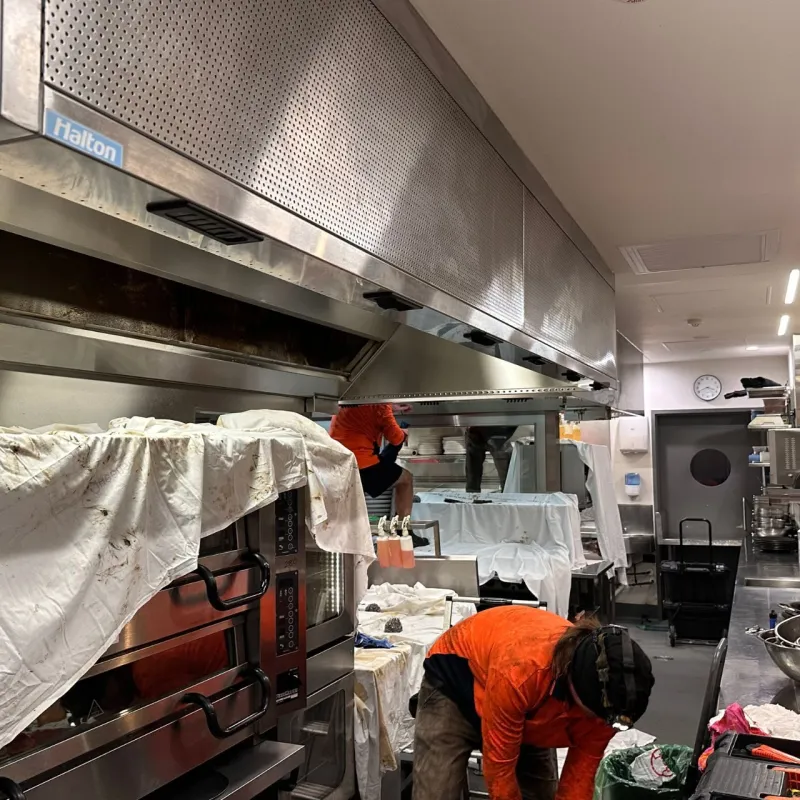
Photo: commercial kitchen extraction ductwork canopy grease cleaning, via www.greasebusters.com.au
Ask a facilities manager where they fear a fire will start and the answers tend to cluster around the obvious: kitchens, plant rooms, electrical panels. Ask a fire investigator the same question and a rather different picture emerges. Home Office incident data and fire and rescue service intelligence consistently point towards the unglamorous spaces at the back of the building — the ones nobody visits unless something breaks.
Three of those spaces deserve particular attention, because each develops its risk slowly, invisibly, and almost entirely out of sight.
The Grease Above Your Head
Commercial kitchen extraction is the classic example of a hazard that grows without anyone noticing. Every cooking session deposits a fine layer of grease onto the inside of the canopy filters and, more critically, the ductwork running above ceiling voids and up through the building. That ducting is warm, poorly accessible, and effectively never seen.
Grease does not need a flame to ignite. A spark from a burnt-out heating element, or simply the temperature of the duct during heavy service, can be enough. Once alight, a duct fire behaves unlike anything else in the building: burning grease travels, and the duct itself becomes a chimney that carries fire through floor after floor. Several of the most serious restaurant and hotel fires attended by UK fire and rescue services in recent years followed precisely this pattern.
The defence is unremarkable but non-negotiable. TR19® guidance, the industry standard for grease cleaning, sets cleaning frequencies based on usage — from annually for light use to as often as monthly for heavy cooking operations. Critically, the work must be evidenced: a post-clean report with photographs of the duct interior. Insurers increasingly ask for exactly this evidence when kitchen-related claims are made, and the absence of a TR19® certificate is one of the fastest routes to a reduced or declined settlement.
The Recycling Store Nobody Visits
Every commercial premises generates waste, and most now have a recycling area — cardboard bales, plastic shrink wrap, paper, packaging waiting for collection. These stores combine three things a fire loves: high fuel load, often compacted into dense blocks; frequent proximity to the building or an adjoining boundary; and near-total absence of supervision.
Compaction makes matters worse. A bale of cardboard or a stack of flattened boxes burns fiercely and resists extinguishment, while the cardboard and plastics in modern recycling streams produce dense, toxic smoke at remarkable volume. Where recycling stores sit against an external wall with windows above, the fire can breach into the building within minutes. Fire and rescue services have repeatedly highlighted waste and recycling fires as a source of commercial premises losses, and automatic sprinkler or suppression protection is rarely present in these areas.
Practical controls are straightforward. Keep recycling at least six metres from the building where site layout allows — more where the store is large. Never store combustible waste against external walls, under fire escape routes, or beneath openable windows. Ensure collections are frequent enough that volumes never build beyond a controlled level, and keep skips and bins locked: arson involving waste containers remains one of the most common deliberately started fire types in the UK.
The Intake Room That Time Forgot
Electrical intake and switch rooms occupy an unusual position in commercial buildings: they are critical, occasionally visited, and almost never cleaned. Dust settles on switchgear, cable trays collect debris from decades of minor works, and storage has a habit of creeping in — a spare chair, old IT equipment, boxes of archived files. Some of it is combustible; all of it is in the worst possible place.
Electrical faults remain a leading ignition source in non-domestic buildings, and the intake room concentrates that risk into a single, poorly supervised space. The controls are dull and effective: keep the room clear of storage entirely, ensure fire doors and seals on the intake room are intact and never propped, maintain a programme of thermographic inspection of switchgear to catch overheating connections before they fail, and confirm that access hatches and service penetrations through the room's walls are properly fire-stopped.
The Common Thread
What links duct grease, recycling stores and intake rooms is that none of them features in the mental picture most people hold of their building's fire risk. They develop quietly, they are excluded from day-to-day sightlines, and they are precisely the locations a fire risk assessor should be scrutinising — and the locations an insurer's loss adjuster will examine first when a claim is submitted.
A claim-free premises is rarely the product of luck. It is the product of routines: the duct cleaned on schedule and photographed afterwards, the recycling collected before it climbs the wall, the intake room swept and sealed. None of it is dramatic. All of it is the difference between an incident and a catastrophe.