Before They Reach the Door: The External Fire Infrastructure Inspectors Notice First
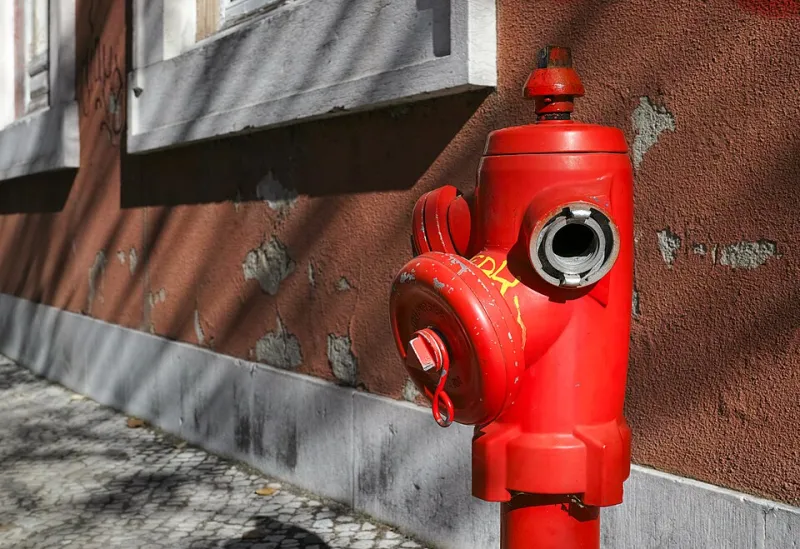
Photo: Jules Verne Times Two, CC BY-SA 4.0, via Wikimedia Commons
First impressions carry weight in fire safety enforcement. An inspecting officer from the Fire and Rescue Service forms a judgement about a premises long before they reach reception — and what they see on the approach often shapes how thoroughly they look at everything else.
In Greek and Roman mythology, Mercury was the swift messenger of the gods, moving quickly precisely because the road ahead of him was clear. The same principle applies to fire appliances. A fire engine travelling at speed with blue lights flashing still needs somewhere to stop, someone to open the gate, and a hydrant it can actually find. When any of those fail, the ground is no longer clear — and seconds are lost.
What Inspecting Officers See Before the Front Door
External fire infrastructure sits awkwardly in most facilities management schedules. It is nobody's daily responsibility, it rarely features on internal audit routes, and its failure is invisible until the worst day of the building's life. Yet the Regulatory Reform (Fire Safety) Order 2005 places a duty on the Responsible Person to ensure that the means of access for the Fire and Rescue Service remain available and unobstructed. That duty does not stop at the threshold.
Officers arriving for a routine inspection or following a complaint will typically note:
- Whether hydrant markers are visible and whether the hydrant pit beneath them is accessible
- Whether hard standing designated for fire appliances is being used for parking, bin storage or grounds maintenance equipment
- Whether gates, barriers and bollards along the access route can actually be opened quickly
- Whether vegetation, signage and general housekeeping suggest a managed or a neglected site
None of these observations alone constitutes a breach. Together, they paint a picture — and an unfavourable one invites a closer look at everything behind the front door.
The Hydrant Problem Hiding in Plain Sight
Private hydrants are among the most commonly neglected assets on commercial estates. Yellow 'H' plates fade, pits fill with silt, and in some cases the hydrant itself has been paved over during car park works that nobody cross-referenced with the water authority.
A hydrant that cannot be located, or that yields a dry or silted connection, costs an attending crew minutes at the most critical point of an incident. Fire and Rescue Services maintain records of hydrants on their patch, but the condition of private hydrants within the site boundary is frequently the owner's problem — and one that surfaces only when it is too late.
Hard Standing: The Space You Keep Clear by Doing Nothing
Designated appliance hard standing exists so that a 12-tonne fire engine can position safely, deploy its equipment and, where required, reach an aerial ladder platform. It is a common and understandable temptation to treat these areas as overflow parking or a convenient spot for the grounds contractor to leave a chipper.
An inspecting officer will not share that flexibility. Blocked hard standing is one of the clearest signals that external access provisions are not being actively managed, and it is the kind of finding that appears verbatim in enforcement correspondence.
Gates, Barriers and the Key That Nobody Can Find
Secured sites present their own difficulties. Roller shutters, coded gates and padlocked barriers are legitimate security measures, but each one must be capable of being opened without delay by whoever is on site — or, failing that, through arrangements agreed with the Fire and Rescue Service, such as secure key boxes.
The classic failure is procedural rather than physical: the barrier works, but the only person who knows the code left the company in March. Access provisions need to be tested and documented with the same rigour as any other fire safety measure.
A Practical External Audit Checklist
Facilities managers can walk their site perimeter in twenty minutes and capture most of what matters. We recommend a quarterly external audit covering:
- Hydrant visibility — marker plates legible, pits free of debris, covers intact and removable
- Hydrant functionality — periodic flow testing arranged with a competent contractor
- Access route width and height — a minimum of 3.7 metres clear width for appliance access on typical sites, with overhead obstructions checked
- Hard standing — unobstructed, load-bearing, and free of parked vehicles or stored materials
- Gates and barriers — openable within a matter of moments by any member of the duty team; keys and codes held by more than one person
- Signage — access routes and assembly points clearly marked
- Housekeeping — vegetation cut back, no combustible storage against external walls, lighting functional
Record the walk-round, date it, and act on findings promptly. As with so much of fire safety compliance, the documented process matters almost as much as the physical condition it protects.
The Signal You Send
A site where hydrants are tested, access routes are respected and gates open freely tells an inspecting officer that the Responsible Person takes the Fire Safety Order seriously. That impression colours the whole visit. Conversely, a faded marker plate over a silted hydrant suggests — fairly or not — that internal provisions may be equally neglected.
Mercury Fire Safety supports facilities managers across the UK with fire risk assessments that include external access provisions, hydrant testing coordination and practical remediation advice. If you cannot remember the last time anyone walked your perimeter with a checklist, it has probably been too long. Clear the ground, and the messenger arrives faster when it matters.